Payroll Dashboard
Design a centralized payroll dashboard that helps payroll managers quickly review payroll status, identify issues, and manage payroll data across multiple locations within strict payroll timelines.
project overview
my role
senior product designer
company
Paycom
timeline
8 weeks
team
product champion, developers
platform
web
understanding the problem
Payroll management demands accuracy, speed, and strict deadlines. Payroll teams handle large, fragmented data from time-tracking, HR, and finance systems, making verification, error detection, and status tracking slow. Multi-state or international operations add regulatory and tax complexity. A centralized, intuitive dashboard is needed to monitor payroll, detect issues early, and streamline payroll cycles.


user pain points
Payroll data is scattered across different parts of the system, making the payroll process slow and increasing the chance of missing or incorrect data.
Errors are difficult to detect before the payroll causing later payment corrections, employee frustration and extra administrative time.
Limited visibility into payroll transactions and their status.
Hard to read data.
Generate reports takes so long and requires so many manual steps causing time and delaying financial planning.
bussiness goals
Reduce payroll processing time
Reduce payroll errors
Improve visibility into payroll operations
Enable data-driven financial decisions
Improve employee payment reliability
contrains
USER ROLES AND PERMISSIONS
Different users have different levels of access. Payroll specialists may need full payroll details, while HR managers or executives may only view summarized information.
MULTI-LOCATION PAYROLL REGULATIONS
Many companies operate across multiple states or countries, requiring the system to support different tax rules, currencies, and payroll regulations.
COMPLEX PAYROLL DATA
Payroll includes multiple variables such as taxes, overtime, deductions, and benefits, which increases the complexity of the data that needs to be presented clearly.
TIME-SENSITIVE PAYROLL CYCLES
Payroll operates under strict deadlines between reconciling employee hours and the payment date, requiring the interface to support fast review and efficient processing.
research
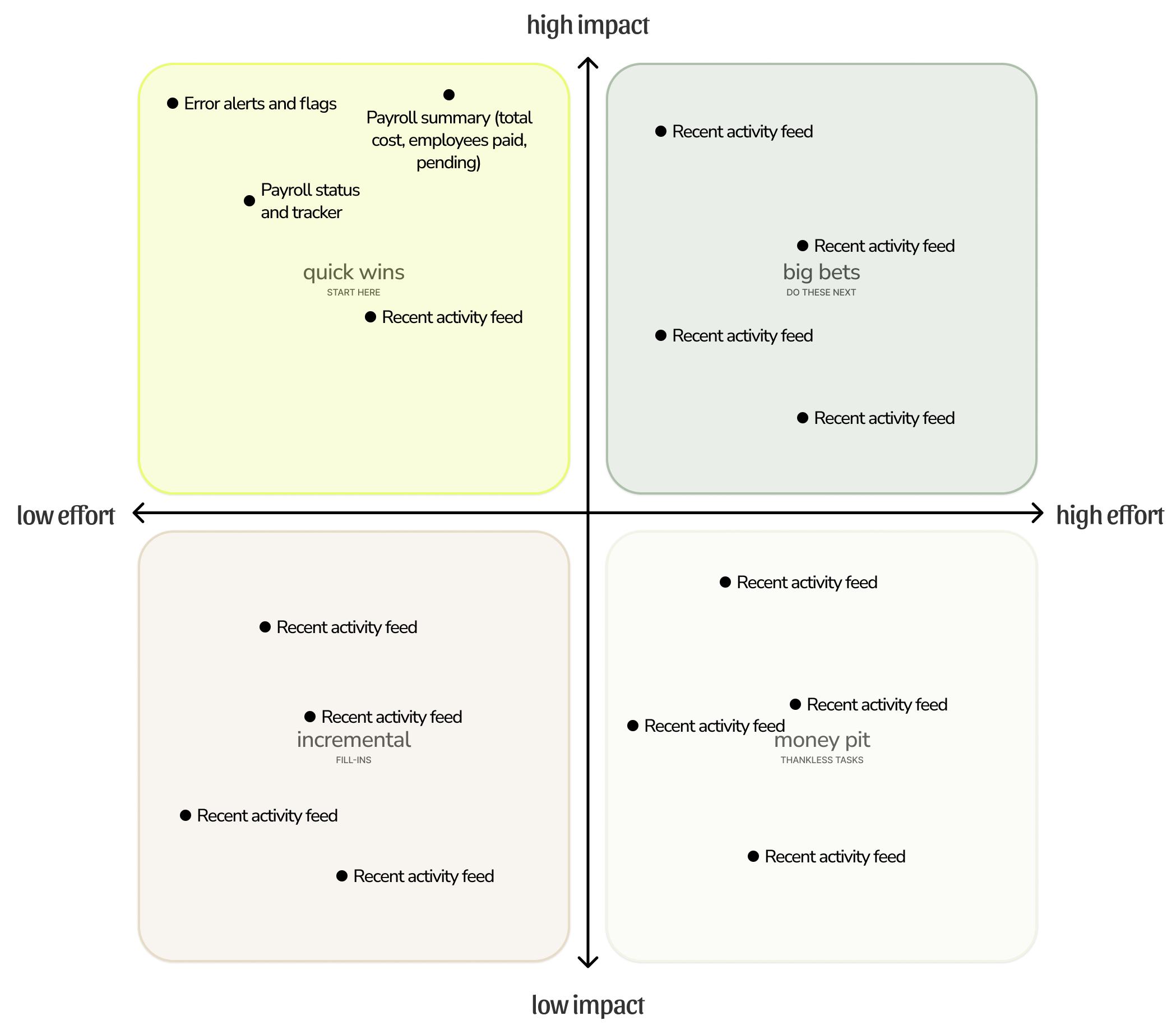
To prioritize features, I used an Impact vs Effort matrix to identify high-value opportunities that could improve payroll efficiency while balancing implementation complexity. This helped focus the design on features that deliver immediate value, such as payroll summaries, status tracking, and error alerts.
learning + reflection
Lorem ipsum dolor sit amet, consectetur adipiscing elit.
Nunc aliquam nibh sed eleifend tempor.
Morbi at massa faucibus, tincidunt justo semper, hendrerit odio.
Nunc rutrum nisi quis erat volutpat, condimentum molestie purus finibus.
Aenean dictum quam sed magna viverra pretium.
research
To better understand payroll workflows and user needs, I explored how payroll teams typically manage payroll processing and reporting. Payroll administrators often work with multiple systems, including HR platforms, time-tracking tools, and accounting software, which makes it difficult to maintain a clear and centralized view of payroll data. Because payroll cycles operate under strict deadlines, users need to quickly verify information, detect errors early, and monitor the progress of payroll processing. Additionally, payroll managers rely heavily on clear summaries and alerts to identify issues before payroll is finalized. These insights highlighted the importance of designing a dashboard that prioritizes visibility, error detection, and efficient navigation through complex payroll data.
results
Reduce payroll processing time by 25–30%
Improve visibility of payroll status and pending issues
Help detect payroll errors earlier in the process
Reduce time spent navigating between multiple tools